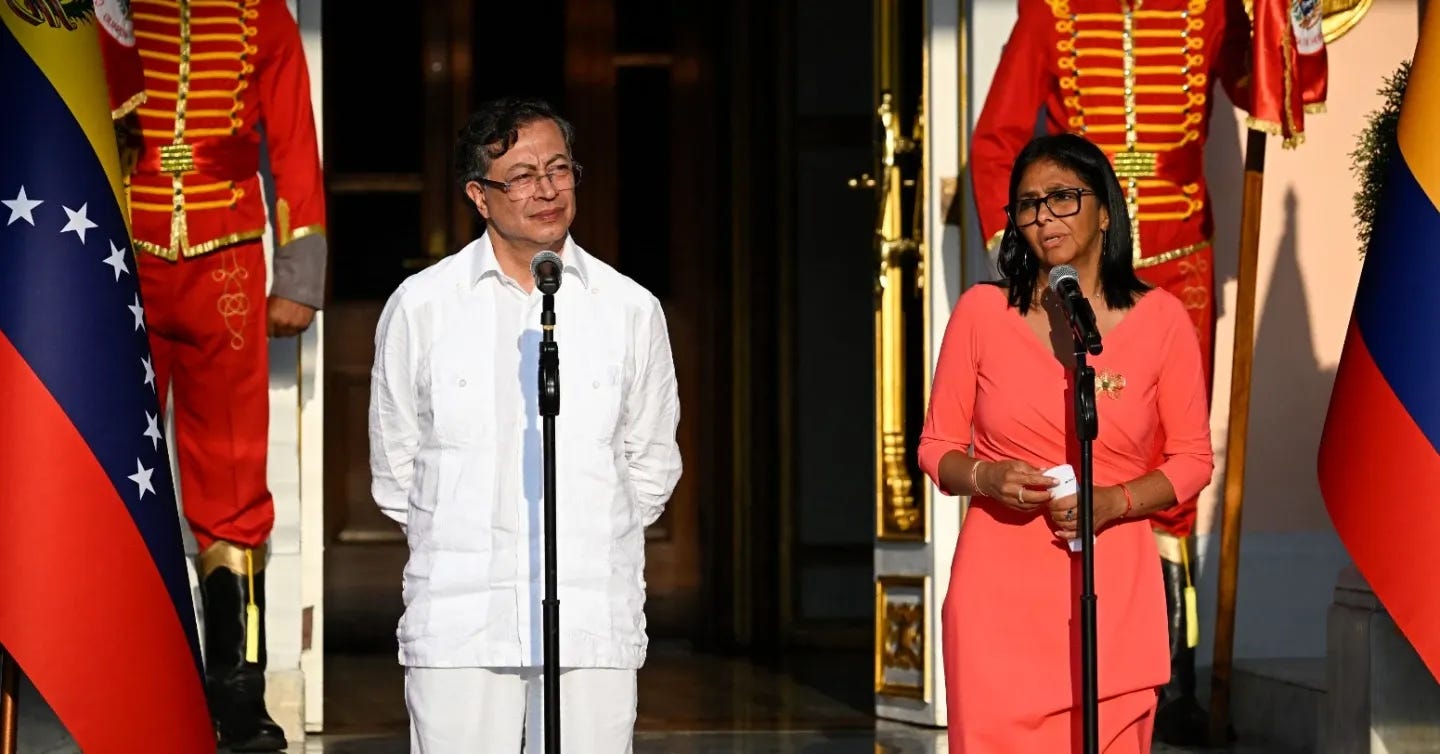
Delcy and Petro Met. For the Last Time?
Petro traveled to Caracas, gave Delcy the legitimacy she was looking for, and received a signed note in return.

This is the first issue of LatAm Explained I’ve written in a couple of weeks. I ended up taking an unplanned break and traveled to Perugia for the International Journalism Festival. There, I attended some great panels and met and reconnected with wonderful people. I also managed to take a few days off, so thank you for sticking around.
After these conversations, I decided to change how I run this newsletter. You’re used to a longer Monday issue with a main news analysis, three news recaps, and a cultural recommendation. The experts I met there suggested that posting more often would help us grow, so now each section will be its own issue: main pieces on Monday, recaps on Wednesday, and the cultural pieces on Friday.
More importantly, to grow on this platform, I was advised to activate paid subscriptions. The explanation is simple: Substack’s algorithm promotes them because that’s how they make money. But don’t worry: if you were subscribed to LatAm Explained before this week, you’ll always get it for free. Thanks for your support from the beginning.
I wanted to share these updates before diving into the news. Now, let’s get started.
Last Friday, Gustavo Petro flew to Caracas, becoming the first foreign leader to visit Venezuela since the United States captured Nicolás Maduro on January 3. Welcomed at Miraflores by Acting President Delcy Rodríguez, the two hugged, posed for photos, and announced deals on border security, energy cooperation, and joint efforts against ELN and FARC groups along the 2,219-kilometer Colombia-Venezuela border.
This meeting had been planned for months, coordinated between Petro and Maduro. However, when the invasion occurred, it changed everything — the meeting was canceled three times before finally taking place. Now, with Petro’s term ending in August and Delcy’s future uncertain, this will likely be the last time they meet.
The timing from Venezuela was notable. The day before Petro arrived, Rodríguez announced from Miraflores, without providing a legal justification, that the amnesty law signed on February 19 had ended. There was no approval from the National Assembly or any constitutional basis; she just casually mentioned it in a speech. Meanwhile, Foro Penal reported that, of 768 political prisoners released since January 8, only 186, about 24 percent, were freed under the amnesty. As of April 20, 473 political prisoners remained in jail, and families had been waiting outside El Rodeo I and El Helicoide for 100 days.
On the same day, before Petro arrived, John M. Barrett, the new U.S. Chargé d’Affaires, landed in Caracas and was welcomed at Miraflores. It is unclear what changed between Washington and Caracas. The amnesty law created the political conditions for Rodríguez to reopen the U.S. embassy, approve Chevron’s new licenses, and lift Central Bank sanctions, among other things. When it fulfilled these functions, it ended. Chavismo has always been skilled at buying time; the amnesty law seems like yet another example.
Petro arrived in the middle of all this: right after the new U.S. envoy came, just after amnesty ended, and after Rodríguez’s 90-day mandate expired with no election or National Assembly debate to renew it. He gave the regime the legitimacy it wanted. Rodríguez thanked him for being “one of the first” to call her government after the invasion. This was exactly what Caracas hoped for.
Meanwhile, the opposition keeps asking for an election calendar that does not exist. María Corina Machado just finished a European trip, where she met leaders from France, Italy, and the Netherlands, among others, culminating in a rally at Madrid’s Puerta del Sol that drew thousands. This event, however, was soon overshadowed by an avoidable scandal: Venezuelan singer Carlos Baute led the crowd in shouting racist insults at Delcy Rodríguez, joined in himself, and Machado, present on stage, did not intervene. The Chavista propaganda machine seized on this for days. The regime, through Jorge Rodríguez, the president of the National Assembly and Delcy’s brother, keeps delaying elections, citing economic recovery as justification.
What did Bogotá get from this? While the security deals are real, as they were signed, Colombia has struggled for years to secure Venezuela’s help against the ELN, with little success; a signed note does not necessarily change things in practice. The energy talks matter because Colombia needs Venezuelan gas, and the western border power lines require repairs. With only 30 percent approval and the first round of elections five weeks away, Petro needed to appear as a regional leader instead of a president hurt by scandals.
Two days after Petro returned, sadly, a bomb exploded on a bus on the Pan-American Highway in Cajibio, Cauca, killing twenty people and injuring thirty-six, including five children. Meanwhile, Colombia’s Armed Forces commander attributed the attack to FARC dissidents: the same groups Petro had signed intelligence-sharing agreements with Venezuela’s cooperation in Caracas.
Iván Cepeda, the left-wing frontrunner with 31 percent in the polls, is likely to benefit from Petro’s regional leadership in his final weeks. Whether that is worth the political cost of legitimizing a government that ended its only political prisoner mechanism the day before the visit is a tougher question. We will see the answer on May 31, the day of Colombia’s first round of presidential elections.
That’s all for now. If you found this valuable, here’s how you can support me:
Subscribe for free and get our Wednesday edition every week: three important stories from Latin America you should know. If you upgrade to a paid subscription, you’ll also get our Monday analytical deep-dive and our Friday cultural pick: a song, show, book, or film to help you better understand our region.
Like this post by tapping the heart button. It helps more people discover LatAm Explained.
Leave a comment below. I read every single one, and your perspectives make my content better.
Share this with someone who’d appreciate my analysis of Latin America. Forward this email, or use the button below:
👋 Meet Felipe Torres Gianvittorio
Felipe Torres Gianvittorio is a Venezuelan-Spanish journalist and editor of LatAm Explained. He helps international readers understand Latin America’s politics, conflicts, and culture, drawing on his experiences in Venezuela, Ecuador, and Argentina.
He is part of the LATAM Network of Young Journalists and currently studies the Erasmus Mundus Master’s in Journalism, Media and Globalization at Aarhus University and Charles University in Prague. His research focuses on the role of media under authoritarian regimes.
Gracias por leer. Hasta la semana que viene.


