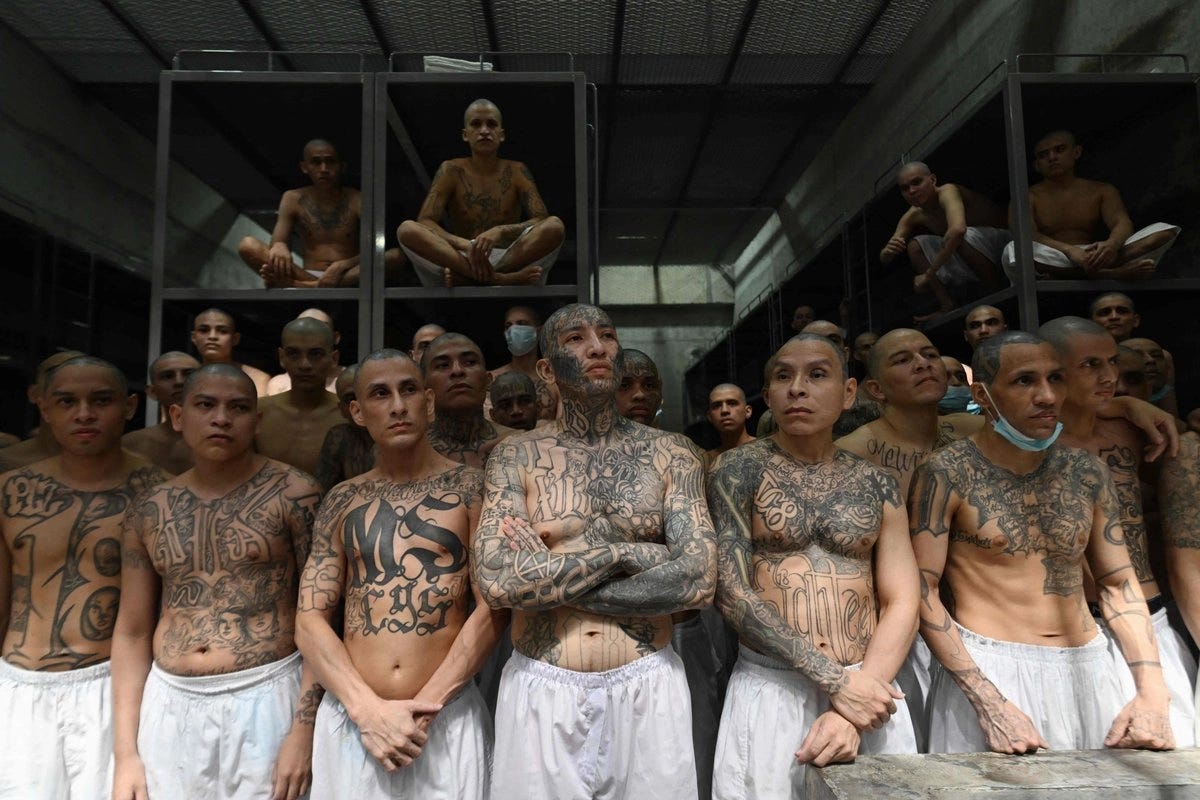
El Salvador Chose Safety Over Rights. Now What?
Mass trials, suspended rights, and 248 gang members sentenced to centuries in prison. The results are clear, but so are the risks.

Si quieres leer esta edición en tu idioma, suscríbete al canal de WhatsApp de LatAm Explained en español.
El Salvador drew international attention this week when courts sentenced 248 MS-13 gang members to exceptionally long prison sentences. One man received a sentence of more than a thousand years. Ten others got between 463 and 958 years each. These convictions were for 43 murders, 42 disappearances, extortion, and other crimes committed from 2014 to 2022. President Nayib Bukele’s government called it historic justice. The Attorney General described the sentences as “exemplary.”
Bukele’s anti-gang crackdown has had a clear impact. Homicides fell from more than 6,600 in 2015 to about 500 in 2022. El Salvador went from the world’s highest murder rate to some days with no killings at all. Extortion, which once crippled businesses, has almost vanished. Neighborhoods that used to be under gang control are now safe to walk in. Since March 2022, authorities have arrested over 90,000 suspected gang members.
It makes sense that Salvadorans support these actions. After three decades of gangs killing thousands and terrorizing communities, people wanted real change. Bukele delivered that. His approval ratings are about 85 percent, and he won re-election in 2024 by a wide margin. When you have lived through so much violence, you are willing to accept trade-offs for peace.
But there is a problem. Bukele has used this success to strengthen his authoritarian image, which was already apparent before the crackdown. He now controls all branches of government after removing Supreme Court judges and the Attorney General in 2021. He changed the Constitution to allow his re-election, even though it was not allowed before. The state of emergency has been renewed more than 30 times, suspending basic rights for almost three years. Mass trials with up to 900 defendants at once raise real concerns about fair legal defense. With over 90,000 people arrested and only about 8,000 released, it is likely that some innocent people are now serving long prison sentences.
This is a difficult decision that no one wants to face. Naturally, people want safety from crime in their daily lives. But in the long run, Salvadorans may regret giving Bukele so much unchecked power and accepting actions that break constitutional rules. When indefinite emergencies, mass imprisonment without due process, and leaders changing rules to stay in power become normal, it is hard to reverse. The gangs may be gone, but the example set is risky.
It all comes down to deciding which difficult situation you can accept. Salvadorans chose safety. The real question is what they gave up for it, and whether the true cost will only become clear in the future.
Mercosur-EU Trade Deal: Almost Dead

A few weeks ago, we talked about the Mercosur-EU free trade agreement. Unfortunately, it’s now looking more likely to fall through. The deal was supposed to be signed at the Mercosur summit in Brazil on December 20, but Italy and France delayed it after facing pressure from their farmers. The new signing date is January 12, 2026, in Paraguay.
Brazilian President Lula pushed Europe to keep things moving, even suggesting he might withdraw from the deal if there were further delays. He changed his mind after Italian Prime Minister Meloni asked him to wait. The Mercosur countries agreed to the delay but said they will not change any terms already agreed on in 2024. They also accepted new European rules to protect EU farmers, but say these rules cannot be used to secretly block trade.
After twenty-five years of talks, the deal is still struggling to get across the finish line. Protests from European farmers now threaten to end an agreement that both sides say they want.
Costa Rica’s Chaves Survives Again

We have reported on President Rodrigo Chaves in the past, and once again he has survived an impeachment attempt. On December 16, Congress rejected a request to remove his immunity, with only 35 lawmakers voting in favor—three short of the 38 needed. The Supreme Electoral Tribunal wanted to try him for allegedly using his office to influence the February 2026 elections. This is the second time in 2025 that Congress has protected Chaves.
Chaves continues to reject the accusations, calling them political theater. He is set to finish his term in May 2026. His ability to stay in office shows how Costa Rica’s political culture is changing. The country, once seen as a model democracy in Latin America, is now showing signs of strain. Chaves has often argued that judges and lawmakers are blocking his plans, while they warn that his leadership is becoming too authoritarian.
Trump Escalates: Oil Seizures and “Stolen Resources”

Trump has changed his strategy on Venezuela, moving from stopping drug boats to seizing oil tankers. In the past few days, U.S. forces took control of several ships carrying Venezuelan crude in international waters. Homeland Security described them as part of a “shadow fleet” moving sanctioned oil. Venezuela called the action “international piracy.”
Trump’s language has become stronger as well. He says Venezuela “stole our oil, land and other assets” and promises to keep up the pressure until these are returned. While this is typical Trump exaggeration, it is true that American companies lost assets during the Chávez era. The legal basis for these actions is weak, but Trump’s goal is clear: he wants regime change.
The reality is complicated. Most Venezuelans living in exile would back these actions if they help remove Maduro. For people who have seen their country fall apart under a dictatorship, the outcome may matter more than the methods, even if Trump’s approach and reasons are open to question.
100 years of Celia Cruz
This year marks 100 years since Celia Cruz was born in October 1925. With only one newsletter left this year, I couldn’t let it end without talking about her.
When I was growing up, I had this image of Celia Cruz as a joyful woman in bright clothes, making music that made adults want to dance. She was all about “¡Azúcar!”, sparkling dresses, and that unforgettable voice. But her story goes way deeper than that.
Celia Cruz left Cuba in 1960, just a year after Castro’s revolution. She went on tour with La Sonora Matancera and was never allowed to return. The government kept her out. When her mother died in 1962, Celia couldn’t go to the funeral. The same thing happened when her father passed away years later. She lived with that sadness for decades, singing about her homeland even though she knew she would never see it again.
The regime disliked her because she stood for everything they wanted to erase: Cuban culture growing internationally outside their control, success based on talent instead of ideology, and a voice that wouldn’t stay quiet about her loss. In Cuba, her music was banned. Playing Celia Cruz became an act of rebellion.
For me, Celia’s most moving performance was actually her last one, which I watched live on TV with my parents during a tribute concert. You could see how important she was by the famous artists who came to honor her. When she sang “I Will Survive” in Spanish, she was frail but still defiant. That moment summed up her life: a woman who survived exile, being erased from her homeland, and turned her pain into music that made the world dance.
That’s all for this week. If you liked what you read, please subscribe.
You’ll get something like this every Monday: one main analytical piece, three important stories from Latin America, and one media suggestion to help you learn more about our region.
You can also follow me on Instagram, X, and TikTok for more.
Gracias por leer. Hasta la semana que viene, and Merry Christmas to those who celebrate.