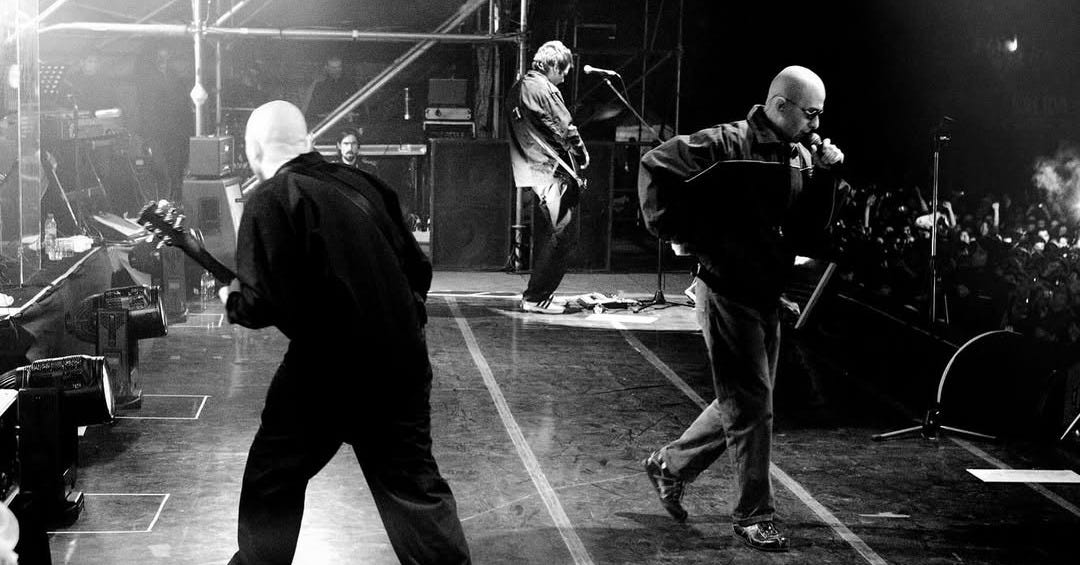
Indio Solari: The Secret Argentina Kept for Itself
Why Argentina is mourning a musician whose meaning was bigger than music.

I moved to Argentina in 2017. It’s a long story, but let’s summarize it like this: I backpacked there because I couldn’t afford airfare to Buenos Aires. That winter, I crossed the border from Chile into Bariloche, deep in Patagonia. My plan was to earn some money there and then head north to Buenos Aires to enroll at the Universidad de Buenos Aires and continue my studies.
I didn’t have a phone because I’d been robbed. My friend Matías lent me one, but I was stupid enough to forget it at the place I stayed in before catching the bus to Bariloche. So when I arrived, cut off from almost everything, I found my first job as a janitor and cook at a small boutique guesthouse near the mountains. I worked from 9 to 5 and had my evenings free.
There wasn’t much to do for entertainment. I could explore the (beautiful) surroundings or watch the communal TV in the lounge, which the owner let me use. Since there weren’t many channels, I ended up spending hours watching the news. That was my introduction to life in Argentina, and there was one story everywhere: the judicial investigation into the Olavarría Indio Solari concert.
All I could think was: How could a single concert draw more than 300,000 people? Who was this guy? How had I never heard of him before?

That was the first time I truly understood how huge Carlos “El Indio” Solari was.
I was already a big fan of Argentine music, as you’ve probably noticed if you read me here. The most influential artist in my life is probably Gustavo Cerati. I had seen Charly García and Fito Páez live. I loved Andrés Calamaro. I knew Argentina had produced some of the greatest Spanish-language rock. At the same time, I was aware there was a band called Los Redondos, but that was about it.
That’s the point: If you’re not Argentine or haven’t lived there long enough to see it for yourself, it’s almost impossible to understand just how big El Indio was.
Patricio Rey y sus Redonditos de Ricota, or Los Redondos, formed in La Plata in the 1970s, in a countercultural scene still under the dictatorship. With Solari’s voice and lyrics and Skay Beilinson’s guitar, they became one of the most unusual mass phenomena in Latin American music.
What really set them apart was the world they built around their music. They stayed away from TV and rarely gave interviews because they distrusted celebrity culture. Before social media, they created a sense of mystery by being scarce. Their albums, symbols, rumors, and concerts all became part of a mythology.
Los Redondos’ fans were called ricoteros, and their concerts were known as “misas ricoteras,” literally “Ricotero masses.” Fans traveled across the country and camped in open fields to later fill stadiums.
By the late 1990s, the band had become an event that cities had to prepare for, creating pressure for everyone involved. Los Redondos played their last show in 2001 and dissolved without a grand public explanation. The usual version is that the partnership among Solari, Beilinson, and those around them had simply reached its limit. After that, Solari disappeared from public life for a few years.
When he returned in 2004 with Los Fundamentalistas del Aire Acondicionado, it was a continuation of the ricotero universe, now openly centered on him, and the band eventually generated the same massive pilgrimages, if not bigger ones. “Ji ji ji,” probably his most famous song, became associated with what Argentines call “the largest mosh pit in the world.” I won’t try to explain it, just watch.
As with many of Argentina's big symbols, like Diego Maradona or Charly García, his politics also play a role. Under the 1990s Peronist-liberal Menem governments, Los Redondos were the soundtrack of a generation, commenting on neoliberal modernity and changes. Then, under De la Rúa, the band’s end coincided almost perfectly with the country’s collapse in 2001.
With the Kirchners, especially Cristina, Solari found more visible points of sympathy, mostly around anti-neoliberalism, one of the main reasons non-fans criticize him. Later, with Milei, his rejection was explicit.
Solari was never neutral, but he was never easy to absorb either. Every government feared or interpreted him in its own way.
The 2017 Olavarría concert I mentioned earlier became his last. By then, Solari’s shows had become almost impossible to manage, and his Parkinson’s disease was already limiting his ability to perform. So yes, the story of El Indio is also one about dangerous devotion, or what happens when music creates a community bigger than the infrastructure built to contain it.

Solari passed away this week at 77, after living with Parkinson’s disease for many years. Argentina mourned the loss of someone who gave voice to a unique national language.
When I was already living in Buenos Aires, my first job was as a waiter and bartender at a hostel bar. The front desk manager, who would, over time, become my dear friend, Nicolás Jaroslavsky, played Los Redondos constantly. And I mean constantly. In the mornings, while I was working, that was the soundtrack.
In a sense, Nico became my Ricotero godfather. Naturally, when I started thinking about writing this, I knew I had to ask him how he felt and how he would describe what El Indio Solari meant to him. Here’s what he said:
That’s the thing about El Indio. You can talk about his work, his politics, and his persona, but it still feels like something is missing. It reminds me of that quote by Oasis songwriter Noel Gallagher: “People will never, ever forget the way that you made them feel.” El Indio is just entangled with the Argentine people’s collective memories.
For foreigners, Los Redondos may still feel hard to access. Their lyrics are poetic, cryptic, and often oniric, and the sound is rougher than the clean elegance of Soda Stereo.
But maybe that’s exactly the point. Some artists become famous worldwide because their work is easy to translate. Others become timeless because they are so deeply tied to one place that translation can’t quite capture them.
Argentina gave the world a lot of music. But El Indio Solari was the secret it kept for itself.
That’s all for now. This would normally be a paid subscriber post, but since this is my little homage to El Indio, I’m leaving it open for everyone. If you found this valuable, here’s how you can support me:
Subscribe for free to get our Wednesday edition every week: three important stories from Latin America you need to know. Upgrade to paid to also receive our Monday analytical deep-dive and our Friday cultural pick — a song, a show, a book, or a film to help you understand the region better.
Like this post by tapping the heart button. It helps more people discover LatAm Explained.
Leave a comment below. I read every single one, and your perspectives make my content better.
Share this with someone who’d appreciate my analysis of Latin America. Forward this email, or use the button below:
Gracias por leer. Hasta la semana que viene.
👋 Meet Felipe Torres Gianvittorio
Felipe Torres Gianvittorio is a Venezuelan-Spanish journalist and editor of LatAm Explained. He helps international readers understand Latin America’s politics, conflicts, and culture, drawing on his experiences in Venezuela, Ecuador, and Argentina.
He is part of the LATAM Network of Young Journalists and currently studies the Erasmus Mundus Master’s in Journalism, Media and Globalization at Aarhus University and Charles University in Prague. His research focuses on the role of media under authoritarian regimes.