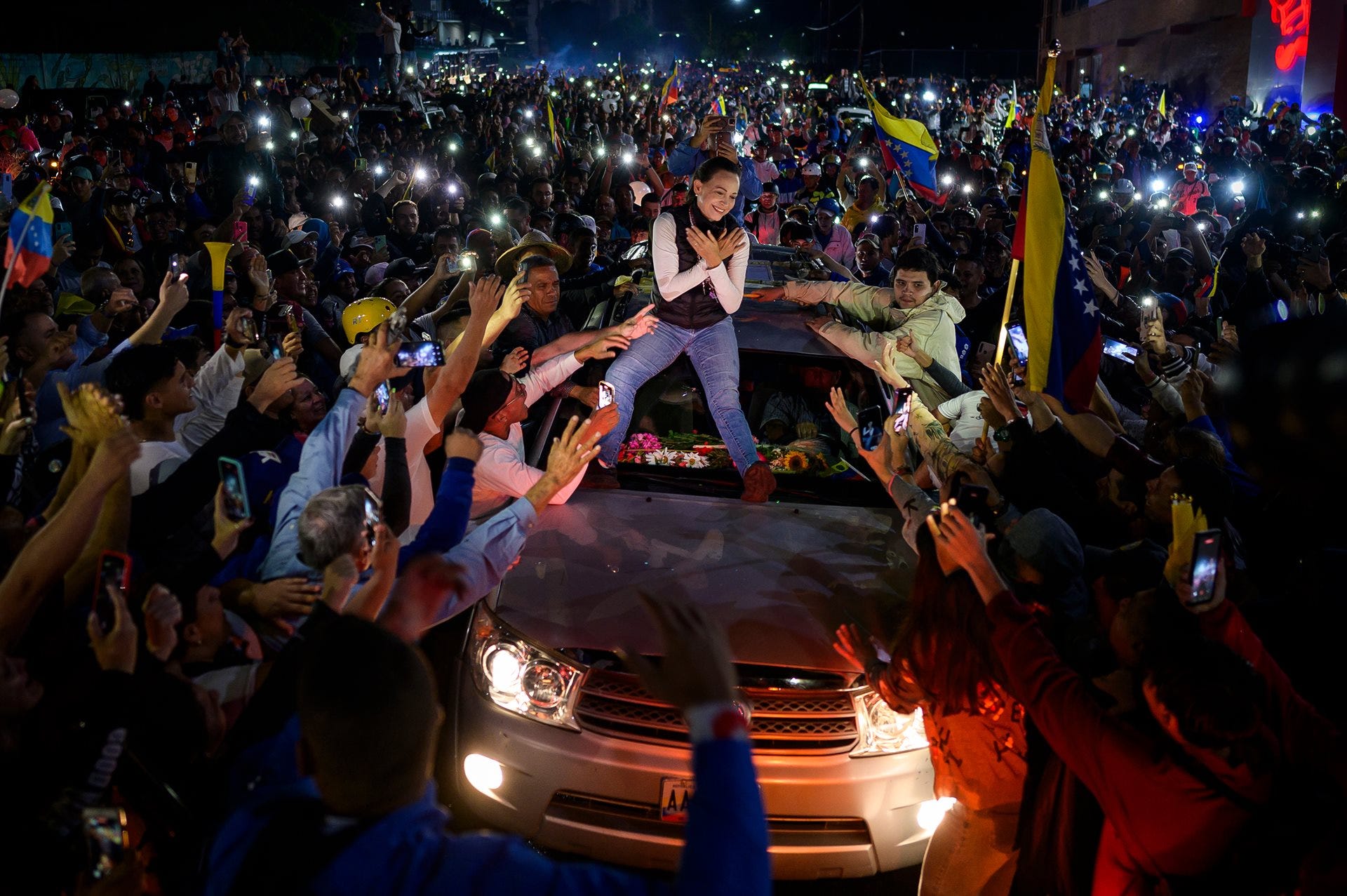
It’s the Nobel Peace Prize, not the Nobel International Allies Prize
I’ve never been the most loyal or vocal supporter of María Corina Machado, but she’s a remarkable, brave, and extraordinary woman.

When María Corina Machado won the Nobel Peace Prize, it was a moment that made every Venezuelan pause. I won’t list her biography or the reasons for the award since that’s been done many times since last Friday.
I actually made an Instagram reel with Argentine BBC journalist Feli Paganti about her background, so if you want more details, you can check that out.
I opened my last week’s editorial saying I try not to talk so much about Venezuela in this channel and focus on other underreported countries. But let’s be honest, if a Venezuelan wins the Nobel Peace Prize, that’s the first story you talk about, no matter what your plans were for the week.
What caught my attention wasn’t the initial reaction, but what happened after. As soon as the news got out, criticism started, especially about her support for Israel and dedicating the award to Donald Trump. People reached out to me, asking how she could win the Nobel Peace Prize, almost as if the award should reflect their own political opinions.
Here’s how I see it: trying to understand the Venezuelan conflict through the lens of other global conflicts — Gaza, Ukraine, whatever — is an act of total myopia. Every conflict has its own background and dangers. Machado has always focused on peacefully standing up to a government that took away democracy, silenced its people, and forced millions to leave. If you only look at her international connections, you miss what really matters.
I’ve followed Machado closely. I know people who know her well. I’ve interviewed her in the past, I did coverage in the opposition headquarters during the 2024 elections, and saw her and her team respond in real time as proof of fraud came in. I didn’t even vote for her in the 2023 primaries, but I can say this for sure: very few people in Venezuelan politics have given up as much or stayed as firmly committed to democracy as she has.
You don’t have to agree with her politics to see what her award means. It’s not about having perfect beliefs; it’s about not giving up. It’s about someone who has spent twenty years facing threats, being banned from running, and government violence, and still chose to keep resisting without using violence.
The Nobel Peace Prize isn’t the Nobel International Allies Prize. It isn’t given for having perfect foreign policy views or for pleasing the world’s political sides. It’s meant to recognize people who keep going when giving up would be easier. In that way, Machado shows the same courage and commitment that has kept Venezuela’s democratic movement alive for years.
You can debate her strategy, her tone, or her politics. But if you’ve lived through what Venezuela has lived through, you know one thing: she earned that medal.
Peru’s Endless Political Hangover

I already talked about Dina Boluarte in this newsletter two weeks ago, mostly to ask how she managed to stay in power despite being so brutally unpopular.
Well, she isn’t in power anymore.
Congress took her out of office, saying she was unfit to lead. Lawmakers used the recent rise in violent crime as the reason they needed. Her approval rating was just 3%, the lowest in the region, and even her last supporters had given up defending her.
Boluarte was Peru’s sixth president in under ten years, just the latest in a now-normal cycle of leaders. She took over after Pedro Castillo tried and failed to take full control, and mostly just stayed in office while protests filled the streets and Congress argued over who should lead. Now, José Jerí is stepping in as temporary president and says he will fight crime. But Peru’s real problem is its broken system. People distrust Congress, political parties don’t mean much, and it’s tough to tell where corruption ends and governing begins.
It’s sad to watch a country get trapped in this loop. Leaders fall, outrage fades, and nothing changes. All I can really do is wish Peruvians the best. I hope that when they finally get to choose again, they can start rebuilding trust in the people who are supposed to represent them.
Brazil’s Supreme Court Justice Barroso Steps Down

Justice Luís Roberto Barroso’s early retirement from Brazil’s Supreme Court surprised many, and some believe the timing was ideal. He led the court during the case when Jair Bolsonaro was found guilty of trying to seize power. Barroso explained that he wanted to step away from the pressures of leadership.
Over his twelve years as a judge, especially during Brazil’s challenges with democracy, Barroso stood out as a strong supporter of the rule of law.
Barroso played a key role in keeping Brazil’s democracy stable during difficult times. His decisions on LGBTQ rights, Indigenous land protection, and reproductive freedom helped define a more progressive era for the court and drew criticism from Bolsonaro’s supporters.
With his departure, President Lula da Silva will appoint a new justice, which could shift the court further to the left for years to come.
The Country That “Doesn’t Exist” Just Held a 600-Couple Wedding

There’s a running internet joke among Latin Americans that Paraguay doesn’t exist, just an empty spot between Argentina and Brazil that people often forget even has a capital. The joke might not be funny, but it shows how little most people know about the country or its history.
This week, though, Paraguay made rare global news for something unexpectedly joyful: a mass wedding of more than 600 couples in Asunción.
The event, which is part of a government program, allowed low-income families to formalize their unions at no cost. Officials say the goal is social inclusion and family rights, but there is also a demographic reason: Paraguay wants to grow its population. Today, the country has just under seven million people, and the effects of its past are still felt. In the 19th century, Paraguay lost up to 70% of its population and has never fully recovered.
So yes, Paraguay exists—and sometimes it even celebrates love on a national scale.
Milo J and the Sound of a New Latin America
The other day, a good English friend asked if I still have hope for Latin America’s future. I absolutely do. I always have, and I always will. Lately, though, my hope feels even stronger thanks to a new wave of young artists. They’re rediscovering their countries’ musical roots and sharing them with the world in fresh ways.
Bad Bunny is the most famous example, with Debí Tirar Más Fotos, his tribute to Puerto Rican tradition and loss. But there’s another artist I find even more exciting.
Milo J, an 18-year-old from Argentina, just released La Vida Era Más Corta, an album that blends rap with Argentine folk music. He brings together zambas, chacareras, and tangos, then adds trap drums, violins, and charangos, making music that feels both old and new. The album features collaborations that might seem unlikely at first, like Mercedes Sosa’s voice appearing after her passing alongside his, or Silvio Rodríguez’s gentle lyrics.
This is more than just looking back. It’s not a ‘folk experiment’ designed for Spotify. It’s a message from a new generation, with an 18-year-old telling his country’s story with surprising wisdom. If you want to see where Latin music is headed, with less hype and more heritage, less algorithm and more heart, start with La Vida Era Más Corta. It shows that the future of Latin America sounds a lot like its past, now heard in full color.
The Follow-Up
In the first edition of this newsletter, I talked about 31 Minutos, the Chilean puppet show that shaped the childhood of many late millennials and early Gen Z in Latin America. I explained why it matters so much to me and how rare it is for something so local to become a cultural reference for the whole region.
Last week, 31 Minutos had its own Tiny Desk Concert, and it already has more than eight million views. The show was as funny and clever as ever, looked amazing, had smart ideas, and included some of those political commentary jokes that only they can do. In the NPR headquarters, they managed to make fun of U.S. immigration and visa policies with humor and elegance.
That isn’t just clever, it’s bold. If you haven’t seen it yet, you should check it out. It’s a great example of Latin American creativity.
Last week, I shared that viral video of someone who looks just like Mexican music legend Juan Gabriel, which sparked rumors that he faked his death and moved to France. I won’t dive into conspiracy theories, but I just learned there’s a new documentary series about him coming to Netflix later this month. If this really is just a coincidence, his PR team has some impressive timing.
The Divo de Juárez died on August 28, 2016, just a couple of months after the last episode of his TV biographical series ended, and while it was still showing in other Latin American countries besides Mexico. My mom and my sister were watching the series every week, I remember, and then Juan Gabriel died. Great marketing move.
Anyway, here’s the trailer for the Netflix documentary.
That’s all for this week. If you liked what you read, please subscribe.
You’ll get something like this every Monday: one main analytical piece, three important stories from Latin America, and one media suggestion to help you learn more about our region.
You can also follow me on Instagram, X, and TikTok for more.
Gracias por leer. Hasta la semana que viene.