What You Missed: Nicaragua, Argentina, Venezuela
Ortega and Murillo keep getting away with terror because too few people are watching.

Nicaragua’s Quiet Terror
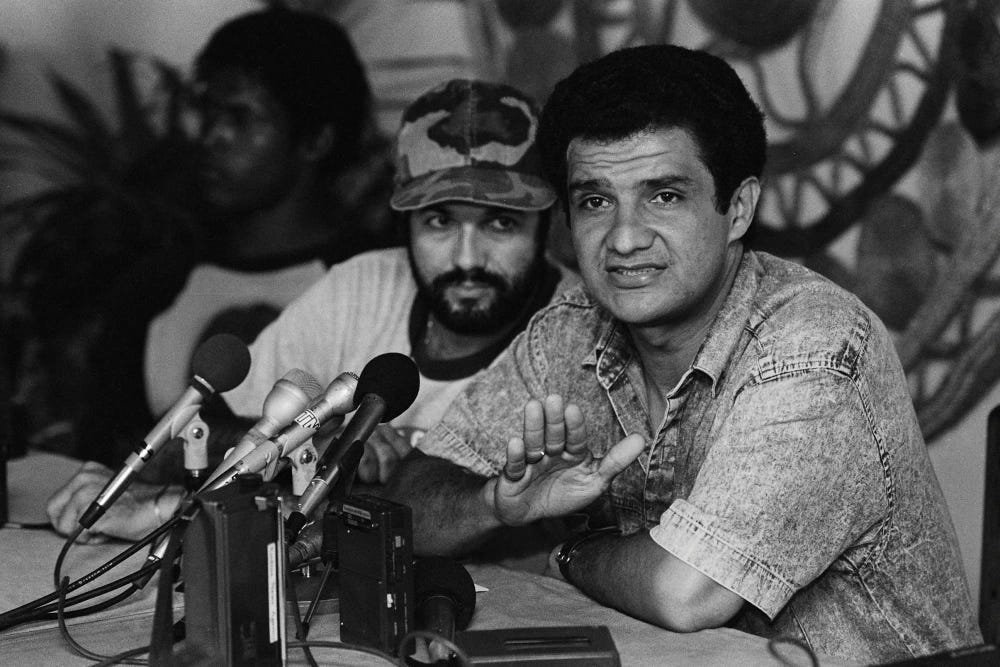
Brooklyn Rivera, one of Nicaragua’s most important Indigenous leaders, died in state custody after nearly three years as a political prisoner under the Ortega-Murillo regime. Rivera was a historic Miskitu leader and a strong advocate for Indigenous autonomy on Nicaragua’s Caribbean Coast. His detention was kept secret for months, and his poor health only became public when he was seriously ill. After his death, his family said the regime would not let them control his body or burial.
This is another example of how Nicaragua’s dictatorship exercises power over life, death, memory, and territory.
We often talk about the three dictatorships in Latin America: Cuba, Venezuela, and Nicaragua. The tragedy is that Nicaragua may be the most repressive of the three, or at least the one where repression is applied with the least visibility. Cuba has decades of symbolic weight. Venezuela has oil, migration, and a regional impact. Nicaragua receives far less attention, which gives Daniel Ortega and Rosario Murillo more room to impose their regime of terror quietly.
This is why Rivera’s death is important beyond Nicaragua. It makes us face a dictatorship that knows how to make people vanish from public life and expects the world to hardly notice.
Bullrich Breaks the Shield Around Milei
A few weeks ago, we discussed how Javier Milei is trying to stay popular amid the challenges of governing. The Manuel Adorni scandal was already hurting the government. Now, Milei’s public clash with Patricia Bullrich shows that these problems are getting harder to ignore.
The most recent conflict happened when Milei’s government withdrew the judicial nomination of María Verónica Michelli, reportedly because she is related to journalist Hugo Alconada Mon, a major investigative reporter in Argentina known for exposing corruption. Bullrich, now a senator in the ruling coalition, refused to back the decision, citing an “objection of conscience.” She did not break with Milei on ideas, but she did make her disagreement public.
Bullrich is not an outside critic. She helped Milei win, served in his government, and remains part of the broader anti-Kirchnerist space. If someone like her is willing to publicly challenge the president, it suggests that the internal discipline around Milei is weakening.
This also brings renewed relevance to the idea of Mauricio Macri emerging as a center-right alternative for 2027. Milei’s contradictions are opening space. The Adorni case, the judicial dispute, and Bullrich’s dissent all point to one conclusion: the government’s anti-casta stance is increasingly difficult to sustain.
Venezuela’s Electricity Problem Becomes Washington’s Problem
Three things happened this week that might seem unrelated but are actually connected. Delcy Rodríguez’s government opened Venezuela’s electricity sector to both local and foreign private investors. Opposition leaders met in Panama to push again for elections. Meanwhile, Marco Rubio reiterated that Venezuela’s transition must be carried out through a democratic vote.
It seems Washington now understands that any recovery in Venezuela, especially one that interests oil companies, must start with fixing electricity. You cannot rebuild production, logistics, hospitals, industry, or oil infrastructure if the power grid keeps failing. For years, Chavismo took pride in public control of key services. It nationalized, centralized, and politicized the system. Now, it has to ask private companies to help fix what it broke.
The same movement that treated electricity as proof of socialist sovereignty now needs private capital, and it needs it under U.S. pressure.
But electricity reform is not a democratic transition. It may help stabilize the country. It may create incentives for investors. It may even give Delcy Rodríguez some breathing room. But it does not solve the legitimacy problem.
This is why the Panama meeting and Rubio’s comments are important. The regime wants to focus on recovery before politics. The opposition and Washington argue that without elections, any recovery will always be fragile. Venezuela needs power, literally. But it also needs legitimacy.
That’s all for now. If you found this valuable, here’s how you can support me:
Subscribe for free to get our Wednesday edition every week: three important stories from Latin America you need to know. Upgrade to paid to also receive our Monday analytical deep-dive and our Friday cultural pick — a song, a show, a book, or a film to help you understand the region better.
Like this post by tapping the heart button. It helps more people discover LatAm Explained.
Leave a comment below. I read every single one, and your perspectives make my content better.
Share this with someone who’d appreciate my analysis of Latin America. Forward this email, or use the button below:
Gracias por leer. Hasta la semana que viene.
👋 Meet Felipe Torres Gianvittorio
Felipe Torres Gianvittorio is a Venezuelan-Spanish journalist and editor of LatAm Explained. He helps international readers understand Latin America’s politics, conflicts, and culture, drawing on his experiences in Venezuela, Ecuador, and Argentina.
He is part of the LATAM Network of Young Journalists and currently studies the Erasmus Mundus Master’s in Journalism, Media and Globalization at Aarhus University and Charles University in Prague. His research focuses on the role of media under authoritarian regimes.