You Really Don’t Understand How Big Mexico Is
And international coverage proved it again.

🇪🇸 Si quieres leer esta edición en tu idioma, suscríbete al canal de WhatsApp de LatAm Explained en español.
Reporting on Mexico has never been easy for me. I’ve visited several times and spent time in states like Mexico, Campeche, Quintana Roo, and Yucatán. Even so, there’s so much to learn that it’s tough to grasp unless you’ve studied Mexico for years. I once told a Mexican colleague that, as someone from outside the country, it’s the hardest place in Latin America to cover. The regional differences, complex history, and economic gaps make it feel like you’re reporting on several countries at once. Here’s my best attempt:
On February 22, Mexican special forces killed Nemesio Rubén Oseguera Cervantes, known as “El Mencho,” the leader of the Jalisco New Generation Cartel, during a military operation in Tapalpa, Jalisco. U.S. intelligence, including the CIA, helped with the operation. Troops used helicopters to attack a compound in the mountains. Cartel gunmen fired powerful weapons. El Mencho was wounded and died while being flown to Mexico City. Eight cartel members were killed, two were arrested, and three Mexican soldiers were wounded.
El Mencho, who was 59, was one of the world’s most wanted men, with a $15 million U.S. bounty on him. The DEA considered his cartel as powerful as the Sinaloa Cartel, with operations in every U.S. state. He kept a very low profile, and all known photos of him were decades old.
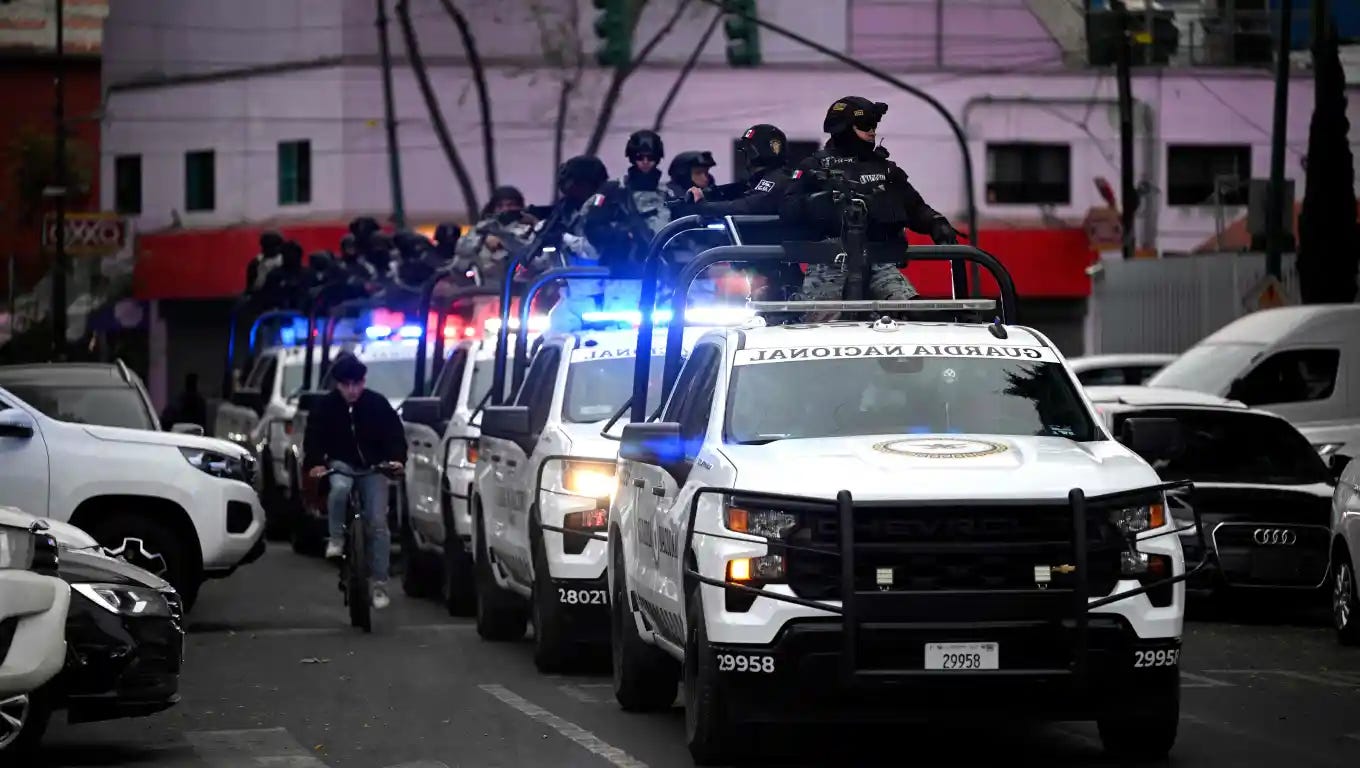
The response was huge. Hijacked trucks, buses, and cars were set on fire. Banks, gas stations, and shops were attacked. More than 70 people died, including 25 National Guard members. One captain died in a car bomb attack. El Mencho’s right-hand man reportedly offered bounties of about $1,100 for each soldier killed. The cartel also used social media to spread false information and add to the chaos.
Guadalajara turned into a ghost town. Smoke rose over hotels in Puerto Vallarta. People ran through airports, and airlines cancelled flights. President Sheinbaum sent 10,000 soldiers to 20 states. Schools were closed, and public transport was suspended in Jalisco.
But here’s what most international headlines missed: most people in Mexico were living their normal lives. The violence was limited to certain states. Life in Mexico City continued as usual, and the northern industrial cities kept working. The violence was real and serious where it happened, but saying all of Mexico was “in chaos” wasn’t true for 130 million people living across almost 2 million square kilometers.
This is why I started this newsletter. International coverage often misses the scale and details of what really happens here.
But there’s one thing everyone should pay attention to. Guadalajara will host four 2026 FIFA World Cup matches in June, just three months away. One of these games will feature Mexico’s national team. Around 3 million visitors are expected.
The cartel has shown it can shut down Jalisco’s capital and tourist areas in just a few hours. Now, there’s a power vacuum. El Mencho’s brother, son, and daughter are all in U.S. prisons, and there’s no clear successor. When El Chapo was arrested, it led to a civil war between Sinaloa groups. History suggests that what happens next could be even worse.
FIFA hasn’t made any public comments. The Mexican government says security will be guaranteed. Still, the images of smoke over Puerto Vallarta and panicked tourists are from just last week. The World Cup starts in June, and that date is coming up quickly.
Milei Is Just Getting Started

Javier Milei kicked off Argentina’s legislative year on March 1st with a passionate two-hour speech. He showed no signs of backing down. Milei promised 90 structural reforms in 2026, saying there would be “nine uninterrupted months” to “redesign the institutional architecture of the new Argentina.”
He is already seeing results. In February, Milei scored two major legislative wins.
The labor reform passed the Chamber of Deputies on February 20th by a vote of 135 to 115. This law updates rules from the 1970s, such as reducing severance pay, making hiring and firing easier, limiting strikes, allowing 12-hour workdays, and encouraging formal job contracts. The government says 40% of workers lack formal contracts. In response, the unions called a general strike, thousands protested, and every Peronist deputy voted against the reform.
On the other hand, the glacier law reform passed the Senate on February 26th by a vote of 40 to 31. The original 2010 law banned mining on Argentina’s glaciers and periglacial areas. Milei’s reform keeps the ban on glaciers but allows mining in periglacial areas and gives provinces more authority. His government says this could attract over $40 billion in mining investment. Greenpeace activists climbed the gates of Congress, and 12 were arrested.
Although I do not agree with many of Milei’s policies or his style, it is clear he has managed to move his agenda forward. He is already the most reform-focused president in Argentina’s history.
The opposition still has not found an effective response. Peronism is divided and the left remains disorganized. Street protests did not stop the reforms, and the strikes did not affect him.
Ahead of the 2027 elections, I think the most likely alternative will not come from Peronism or the left, but from moderates within Milei’s own coalition. It would not be surprising if former President Mauricio Macri tries to fill that space, backing reforms but criticizing Milei’s style, and representing the center-right without kirchnerismo.
Milei seems stronger than ever. If his project faces a challenge, it will probably come from within his own ranks, and Macri knows this.
Peru’s Eighth President in Ten Years
I was surprised when Congress really went through with impeaching José Jerí. On February 17th, just two weeks ago, they voted 75-24 to remove him over “Chifagate.” The scandal was about secret meetings with a Chinese businessman who has a state energy concession. Jerí said the meetings were for a Chinese-Peruvian friendship event and described the visits as “shopping trips.”
After an unusual 24 hours without a president, Congress chose 83-year-old José María Balcázar as the new leader. He is a former Supreme Court judge and a leftist lawmaker from Perú Libre, the same party as former president Pedro Castillo. Balcázar beat three other candidates and promised to “guarantee a peaceful and transparent democratic and electoral transition.” He will serve until July 28th, when the winner of the April 12th election takes office.
Balcázar is the eighth person to become president of Peru in the past ten years. This Congress has now impeached three presidents: Castillo in 2022, Boluarte in October 2025, and Jerí in February 2026.
Balcázar is also facing serious allegations. Still, what Peru needs most right now is a pause from political conflict. It makes sense to let him stay in office until the elections. After the April 12th vote, hopefully the next president can finish their term.
This year, a record 34 candidates are running for president in Peru. The main contenders are Lima’s right-wing mayor Rafael López Aliaga and the well-known Keiko Fujimori. What’s striking is that, despite all the social and political challenges, the economy is still strong and stable, which is rare in the region.
Rodríguez Continues to Please Washington

Chavismo keeps dismantling its own system, or at least putting on a show of doing so to please Washington.
On February 12, thousands of Venezuelan students marched for National Youth Day in the first major opposition protest since Maduro was captured. That same day, the National Assembly passed an amnesty law, pardoning hundreds of political prisoners. By February 25, Attorney General Tarek William Saab, one of Chavismo’s most loyal figures, resigned. Analysts say this is part of Delcy Rodríguez’s efforts to strengthen her position and a reshuffling of institutions supported by Washington.
Even small acts of defiance are fading away. The Venezuelan government took down an official statement that quietly criticized the U.S. and Israeli attacks on Iran. The government is making efforts to silence dissent.
But here’s what everyone is talking about: during Trump’s State of the Union address, former opposition presidential candidate and political prisoner Enrique Márquez was shown on camera. Don’t mix up Márquez with Edmundo González; Márquez ran his own campaign and stayed skeptical of the official results that declared Maduro the winner over González.
Some analysts have started to wonder if the White House is planning a role for him in the transition, maybe even as a presidential candidate. I doubt that. To me, his appearance seemed like a TV stunt. Trump understands television, and Márquez’s appearance felt just like that: a cameo.
On March 1, María Corina Machado said in a video that she plans to return to Venezuela “in the coming weeks.” She is now in the United States, after leaving in December to receive the Nobel Peace Prize in Oslo. She said she met with Trump, Rubio, several heads of state, 10 foreign ministers, 17 U.S. senators, and 27 members of Congress during her 80 days outside Venezuela. Acting President Delcy Rodríguez warned that if Machado returns, she will have to “answer to Venezuela” for allegedly supporting the U.S. invasion. The amnesty law clearly excludes anyone prosecuted for promoting foreign military action, a rule many think is aimed directly at Machado.
Now that Machado has announced her return, we can expect plans for a new presidential election to start coming together in the next few months. Whether Chavismo will allow a free and fair vote is still uncertain.
Willie Colón: Latin America’s Most Influential Musician

I knew that at some point I was going to write about Willie Colón here (and Héctor Lavoe, and Rubén Blades), but I didn’t think it would be under these sad circumstances.
As a Venezuelan writing this newsletter, I try to stay aware of my own perspective and avoid presenting it as the typical Latin American view. But when it comes to Willie Colón, who was incredibly popular in Venezuela, I can say without hesitation that with his death on February 21st at age 75, we have lost the most influential musician in Latin America over the past 50 years.
Willie Colón signed with Fania Records when he was just 15 years old. His first album, El Malo (1967), came out when he was 16 and sold over 300,000 copies. Even as a teenager, he led an orchestra and helped shape what would become salsa music, blending jazz, funk, R&B, and rock with Afro-Caribbean rhythms in a way no one had done before. He also brought the gangster theme into salsa, and his album covers are some of Fania’s most iconic. I’ve been trying to find an original poster from the album La Gran Fuga (1970). If anyone reading this has one, please let me know.
His partnership with Héctor Lavoe gave us some of the most iconic songs in Latin American music, like “Che Ché Colé” and “Aguanile.” Later, his work with Rubén Blades led to Siembra (1978), the best-selling salsa album ever. The standout track, “Pedro Navaja,” brought social themes to salsa by referencing Kafka and Brecht and telling a story about street life. My colleagues from Los 600 de Latinoamérica consider Siembra the most important album of all time in Latin American music, and I agree.
He kept pushing boundaries as a solo artist and producer. Throughout his career, he made more than 40 albums, sold over 30 million records, earned 9 Gold and 5 Platinum records, and was nominated for 10 Grammys. He also worked with artists like Celia Cruz, Ismael Miranda, and Soledad Bravo. His trombone, which isn’t usually a lead instrument in Latin music, became, as his manager Pietro Carlos said, “the voice of the people.”
Colón was a controversial figure in politics. He worked as a special assistant to New York City Mayor David Dinkins, ran for Congress in 1994, and ran for NYC Public Advocate in 2001. In his later years, he strongly supported Donald Trump. He was also active in causes like Latino issues, AIDS awareness, and immigrant rights. Some people admired his political work, while others found it divisive. Still, his influence on our culture is undeniable.
I think some of his best work came early in his career—with Lavoe, with Blades, and even with Celia Cruz—but I’d recommend the album Fantasmas (1981), where he also sings. My favorite song by him is on that album: “Amor Verdadero,” a merengue with a disco feel. You can also hear some of the Brazilian influences there, showing just how wide his musical range was and how he never let himself be limited to one style.
Latin America has lost a giant. His music spoke about identity, pride, resistance, and joy. That legacy will live on.
A Personal Note
You might already know that I run this project by myself. If you’ve read earlier editions, you also know I’m studying for my master’s in Prague, focusing on political transitions and totalitarian regimes through the Erasmus Mundus Journalism program at Charles University.
Recently, I lost my funding for the program, so I started a GoFundMe to help me keep working on my thesis. I explain everything in this video.
That’s also why I missed sending the newsletter last week. I’m doing my best to fix this, and most of my free time is going into it.
I then, humbly, ask you for the following things:
1) Please share my Instagram reel or GoFundMe link, and if you can, consider making a donation. I’d really appreciate it.
2) I’ve also turned on the pledge option here on Substack. If you find my work valuable, please think about supporting it. The newsletter will always be free, so any donation is totally up to you.
Thank you so much.
That’s all for now. If you found this valuable, here’s how you can support me:
Subscribe for free to get editions like this every week: one main analytical piece, three important stories from Latin America, and one cultural recommendation to help you understand our region better.
Like this post by tapping the heart button. It helps more people discover LatAm Explained.
Leave a comment below. I read every single one, and your perspectives make my content better.
Share this with someone who’d appreciate my analysis of Latin America. Forward this email, or use the button below:
You can also follow me on Instagram, X, and TikTok for more of my content.
Gracias por leer. Hasta la semana que viene.