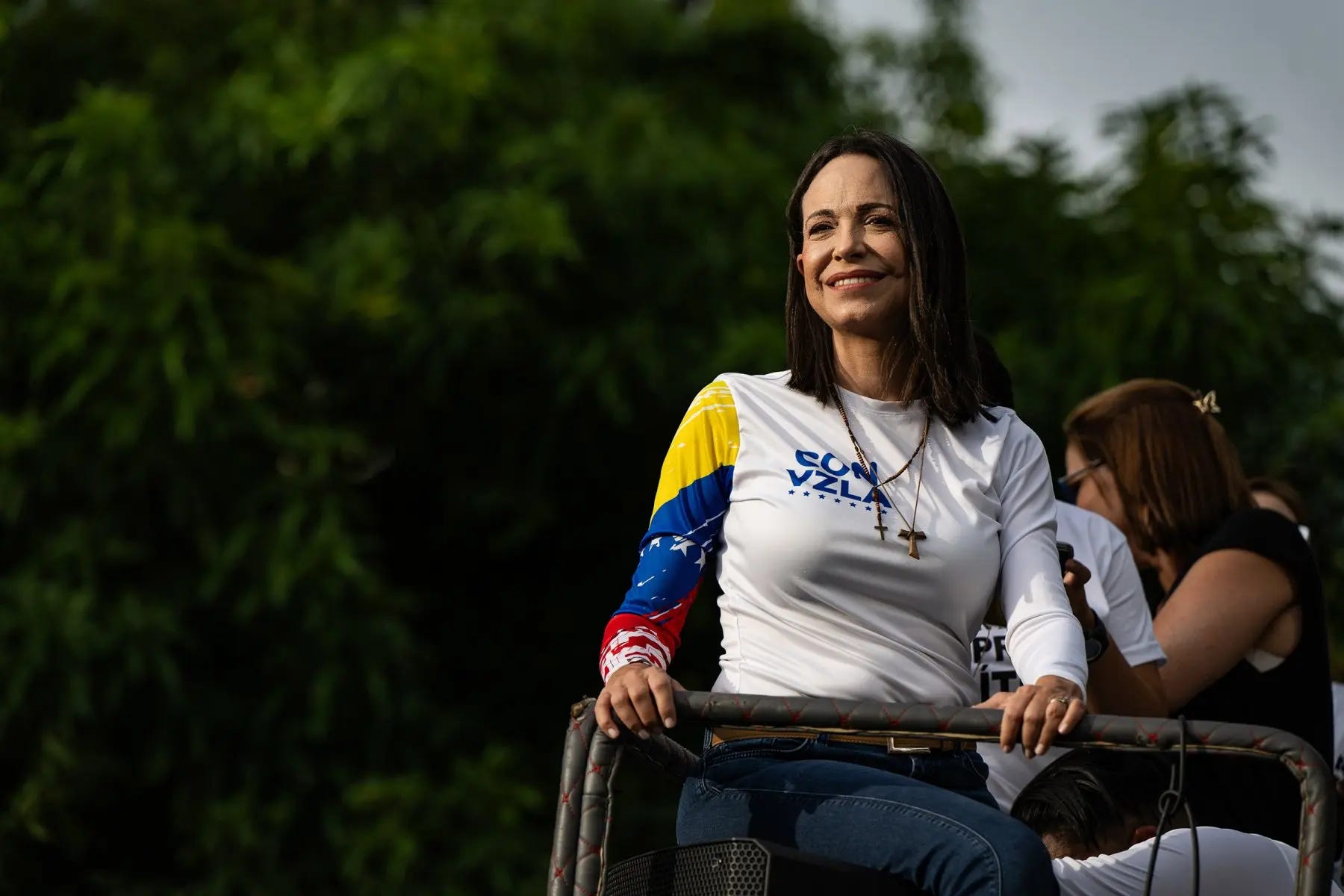
Hidden in Venezuela, Honored in Norway
María Corina Machado's trip to Oslo forces the regime — and the world — to react.
Si quieres leer esta edición en tu idioma, suscríbete al canal de WhatsApp de LatAm Explained en español.

We’ve already talked about who María Corina Machado is and what her Nobel Peace Prize win means. Now, let’s look at what could happen in the days leading up to the December 10 ceremony in Oslo. This trip could be a turning point in one of the riskiest moments of her political career.
Machado has been in hiding since July of last year. This began after Maduro claimed victory in the presidential elections. Despite remaining in Venezuela, staying there is dangerous for her. In early 2025, state security forces detained and questioned her, then let her go a few hours later. Since that incident, she has kept out of sight. The government knows she is still in the country, but not her exact location, and she knows that appearing in public could mean arrest or being forced to leave.
It is now confirmed that she will travel to Norway, which is a big decision. Leaving Venezuela could set off a chain of events. Maduro’s government might block her from coming back, make up charges—the Attorney General has already advanced in this, or accuse her of “abandoning” the country. Or, they might let her leave, since stopping her before the Nobel Prize ceremony could cause an international scandal. Either way, the government has a tough choice, and the world will be watching.
She will not go to Oslo alone. Joining her will be several well-known international figures—including presidents Milei from Argentina, Noboa from Ecuador, and Mulino from Panama—as well as former presidents, lawmakers, members of the European Parliament, human rights activists, and politicians who see her win as a stand for democracy in the region. The Nobel ceremony will unite diplomacy, politics, and human rights in an unprecedented moment.
At this point, arguing about whether she “deserves” the Nobel is tiring and misses the point. If people oppose her because of her views on Israel or her international ties, it really means they do not care about Venezuelans. Machado’s award is not a moral judgment from above. It honors twenty years of peaceful resistance against a government that has harmed, persecuted, and killed its own citizens.
All of this leads to what matters now: how she will get to Norway, what happens while she is there, and what will happen when she tries to come back. With Venezuela on the edge of a new chapter, this trip could either lead to something bigger.
Mexico Gets Ready to Host the World Cup

Last week’s bizarre World Cup draw announced that Mexico will host the opening match of 2026 at the renovated Estadio Azteca. If you ask me, this is a moment of pride and excitement, but I’m also disappointed the final won’t be there, especially since the Azteca hosted the 1970 and 1986 finals.
However, the bigger concern is the challenges Mexico faces as it prepares to host the tournament.
Mexico will host only 13 of the 104 World Cup matches, which shows its smaller role in a tournament mostly run by the U.S. Claudia Sheinbaum’s government is hurrying to finish airports, highways, and stadium upgrades, and not answering questions about the private deal for the Azteca renovation. Officials promise everything will be ready, but building things is just one part of the challenge.
For many, preparations for the World Cup underscore a troubling trade-off: spectacle is prioritized over solving urgent, everyday problems for the local people.
A Mayor Was Killed in Broad Daylight in Guatemala

Guatemala was shaken this week by the murder of Nelson Luciano Marroquín, the mayor of Masagua, who was shot during a Christmas parade. His bodyguard was seriously injured. The attack happened in front of families gathered for a holiday event, which made it even more disturbing.
This is not a new problem. In recent years, many local officials in Guatemala have been killed. Mayors often handle daily issues like road repairs, permits, and land disputes, which puts them in the middle of conflicts involving gangs, drug groups, and political rivals. In over 90 percent of these cases, the attackers go unpunished.
President Bernardo Arévalo has asked for a quick investigation. This is his first big security challenge since he took office. The murder happened soon after twenty members of Barrio 18 escaped from prison, and gang activity has gone up in several areas. Guatemala’s institutions need to respond quickly, or violence will continue to affect the country’s politics.
Puerto Ricans Will Have to Pay More for Electricity

Puerto Rico is about to see electricity rates go up again, and it’s no surprise that people are upset. The island already pays some of the highest prices in the country—usually between 27 and 30 cents per kilowatt-hour—but the service is still unreliable. Blackouts are common, and repairs take a long time. Privatization was meant to fix these problems, but most people feel things have only gotten worse.
LUMA, which delivers electricity, and Genera PR, which runs the power plants, are both unpopular. The Oversight Board says higher prices are needed to fix the Puerto Rico Electric Power Authority’s financial problems, but that does little for families who now pay more each month for a service that often doesn’t work.
The political arguments are nothing new. Washington blames mismanagement, the local government blames the private companies, and the companies blame years of public neglect. Meanwhile, Puerto Ricans keep paying more for electricity that still goes out when it shouldn’t.
Bad Bunny: Four-Time Global Streaming King

Speaking of Puerto Rico. If you’re reading this, you already know who Benito is. Being the most streamed artist in the world for the fourth year in a row isn’t just luck. His journey started far from stadiums and global charts.
Bad Bunny used to bag groceries in Vega Baja and record songs in his bedroom. He shared his music on SoundCloud while juggling school and work. After “Diles” became popular, DJ Luian found him, and soon his deep voice and unique style were everywhere. From there, his path wasn’t easy. He didn’t let his first managers control him. He chose his own direction and built his career with Rimas. That freedom made all the difference.
Benito is known for more than just his streaming numbers. From the start, he’s used his fame to celebrate Latin American culture and musicians. In 2019, he made Oasis with J Balvin and invited Marciano Cantero from Enanitos Verdes to sing “Un Peso”.
In 2020, he started his album with a bit of “The Girl from Ipanema” in “Si Veo a Tu Mamá”. Later that year, he paid tribute to Billo’s Caracas Boys by including “Cantares de Navidad” on El Último Tour del Mundo. And to me, “Trellas” feels like a love letter to Gustavo Cerati.
His latest album, Debí Tirar Más Fotos, once again shows his pride in being Puerto Rican. Now he’s a global superstar, still singing the music he loved growing up and staying true to his language and style. That’s what makes him different. The world’s biggest artist is a Puerto Rican who once worked at a grocery store. Benito really earned this.
The Follow-Up
Last week, I held off on sending the newsletter for a few hours to see if the election results from Honduras would come in. Looking back, I’m glad I didn’t wait any longer, since a week later, the country still doesn’t have a president.
With almost 90 percent of the votes counted, Trump-backed Nasry Asfura has about 40.2 percent, while Salvador Nasralla has 39.4 percent—a difference of less than twenty thousand votes. Rixi Moncada from the government party is still far behind, but her party is now calling for the entire election to be canceled. They say the digital vote count was tampered with, the results system was down for long stretches, and more than 5,000 vote records have problems. The electoral authority has missed several deadlines, and now even international observers are openly urging them to move faster.
This situation is unusual. Honduras went from a peaceful election day to a slow-building crisis, much like what happened in 2017. Until the final results are released and people trust them, the country is stuck in limbo, and there is plenty of reason to question the outcome.
That’s all for this week. If you liked what you read, please subscribe.
You’ll get something like this every Monday: one main analytical piece, three important stories from Latin America, and one media suggestion to help you learn more about our region.
You can also follow me on Instagram, X, and TikTok for more.
Gracias por leer. Hasta la semana que viene.